
Only 3% of sober and sober-curious daters want a bar for a first date. Three in four have been on one anyway.

Content Written By:
SUD treatment executive, national news contributor & keynote speaker.
Navigation:
- Overview
- Key Takeaways
- Dating Culture Runs on Alcohol
- The Cost of Turning Down a Drink
- Hiding It, Faking It, Skipping It
- Almost Nobody Wants To Go To The Bar
- The Dating App Filter That Does Not Exist
- Sobriety Is Not the Dealbreaker People Expect
- What Sober Daters Are Actually Asking For
Overview
Only half of American adults under age 35 say they ever drink alcohol — an all-time low in modern history. Despite it becoming more popular than ever to choose not to drink, dating culture hasn’t caught up. New matches ask to grab a drink, and first dates order a bottle of wine without asking if you planned to share. For the half of young Americans who don’t drink, finding a partner who respects that decision can be more difficult than they expected.
To learn more about how drinking culture shapes modern dating, Drug Rehab USA surveyed 1,000 U.S. adults who are actively dating and either not drinking or cutting back on their drinking. We asked where they want their dates to happen, where those dates actually happen, and how people react when they turn down a drink. Their answers reveal how dating while sober can change every aspect of the process.
Key Takeaways
- Two in three (66%) have felt judged for choosing not to drink or use recreational substances—and 65% have felt pressure to drink on a date, rising to 75% among Millennials.
- 62% have ordered a non-alcoholic drink made to look alcoholic to avoid questions or attention, climbing to 77% among Gen Z and 74% among millennials.
- 75% have gone on a date at a bar or nightlife venue when they would have preferred an alcohol-free setting, rising to 83% among Gen Z.
- 61% have had someone stop responding after learning they don’t drink, and 67% have had a date seem less interested once it came up.
- 64% have avoided going on a date because they expected drinking or substance use would be part of it, rising to 77% among Gen Z and falling to 41% among Boomers.
- Two in three (66%) would use a dating app filter to match with people who are sober, sober-curious, or cutting back, rising to 73% among millennials.
- Four in five (80%) would be more interested in a second date if the other person respected their decision not to drink, while being pushed to drink anyway makes 55% less interested—a figure that splits sharply by gender, at 63% of women versus 43% of men.
- 42% feel more confident being themselves since they stopped drinking or started cutting back, 37% feel safer on dates, and 37% save money.
Dating Culture Runs on Alcohol
While a potential match may never outright ask their date to drink, there’s implicit pressure all throughout the dating world. “Grabbing a drink” is shorthand for getting to know each other, which requires sober daters to either explain their lifestyle or reject the advances.
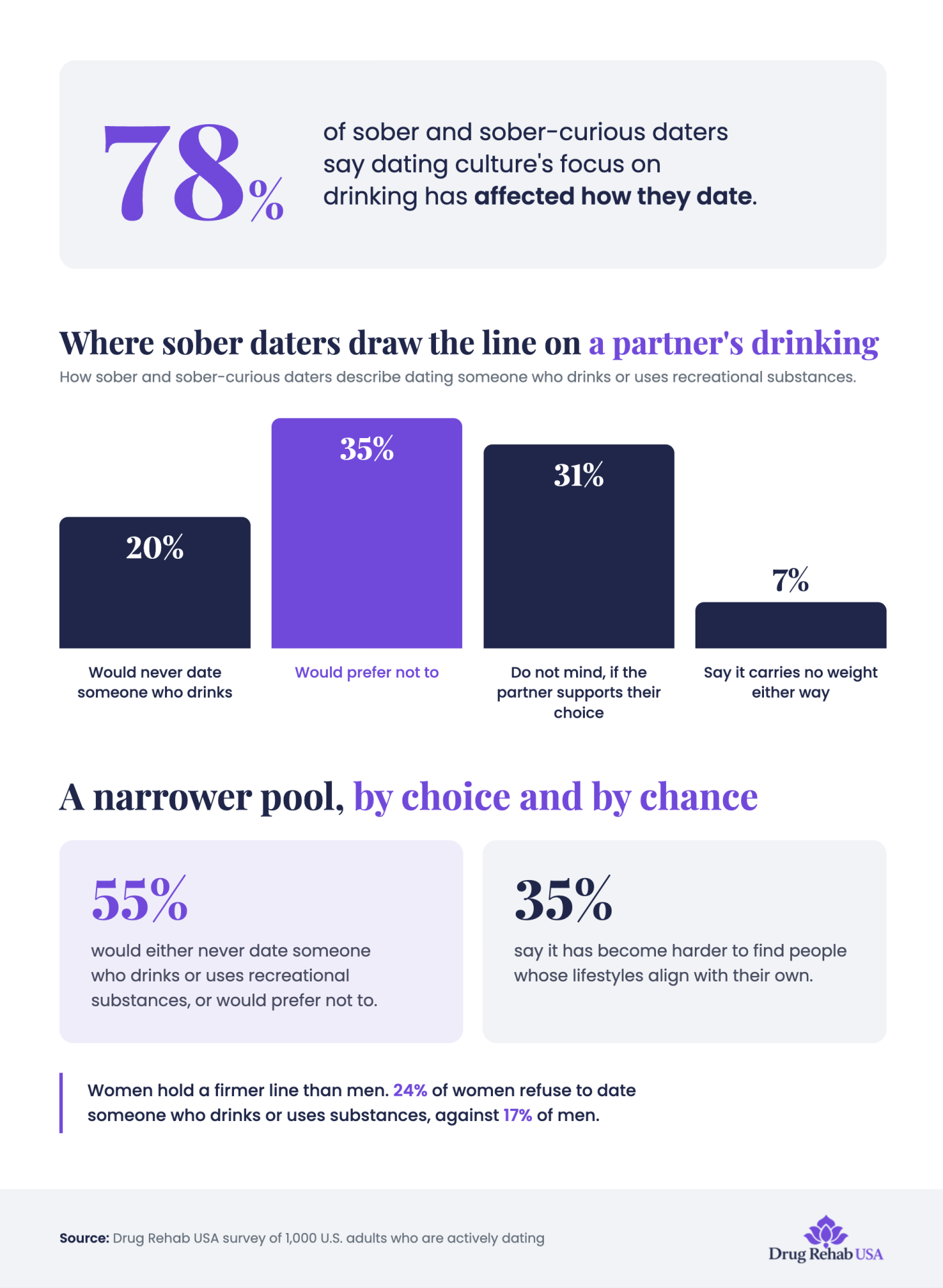
Over three-quarters (78%) of respondents said dating culture’s focus on drinking has affected how they date. This has led 35% to say it’s become harder to find people whose lifestyles align with theirs. A combined 55% would either never date someone who drinks or uses recreational substances (20%) or would prefer not to (35%). Another 31% do not mind a partner’s habits as long as they support their own decision to abstain. Only 7% said a partner’s use carries no weight either way.
Women held a firmer line, with 24% refusing to date someone who drinks or uses substances, while only 17% of men said the same. Conversely, 11% of men thought a partner’s substance use was unimportant, nearly triple the 4% of women who agreed.
Baby boomers were the generation that was most okay with partners who partake: 41% are comfortable dating someone who drinks so long as that person respects their own decision, compared with 28% of Gen Z and 27% of millennials. However, Zoomers had the least trouble finding a partner whose lifestyle aligned with theirs, at 23% compared to 40% of Gen X and 39% of millennials. Younger generations are cutting back on their drinking and drug use in general, earning themselves a reputation for eschewing alcohol and partying. But Gen Z isn’t interested in how they’re perceived by their older cohort; they just want to find a compatible partner.
A smaller share (17%) have stepped away from dating entirely because it felt too centered on drinking. Another 13% turned down specific dates that would involve drinking, and 11% said that sobriety limited their dating opportunities overall. Gen Z was most likely to step back from dating overall at 29%, while boomers were the least likely at 6%. While staying sober is the best personal choice for many singles, the trade-off can be an extremely limited dating pool.
The Cost of Turning Down a Drink
Navigating the dating world as someone who doesn’t drink or use substances can feel like learning to ride a bike all over again. While they may not have batted an eye at their date drinking in the past, it may be a dealbreaker now. Group dates become uncomfortable when you’re the only one not sharing the bottle of wine. The dating world changes when you’re sober, and here’s how.
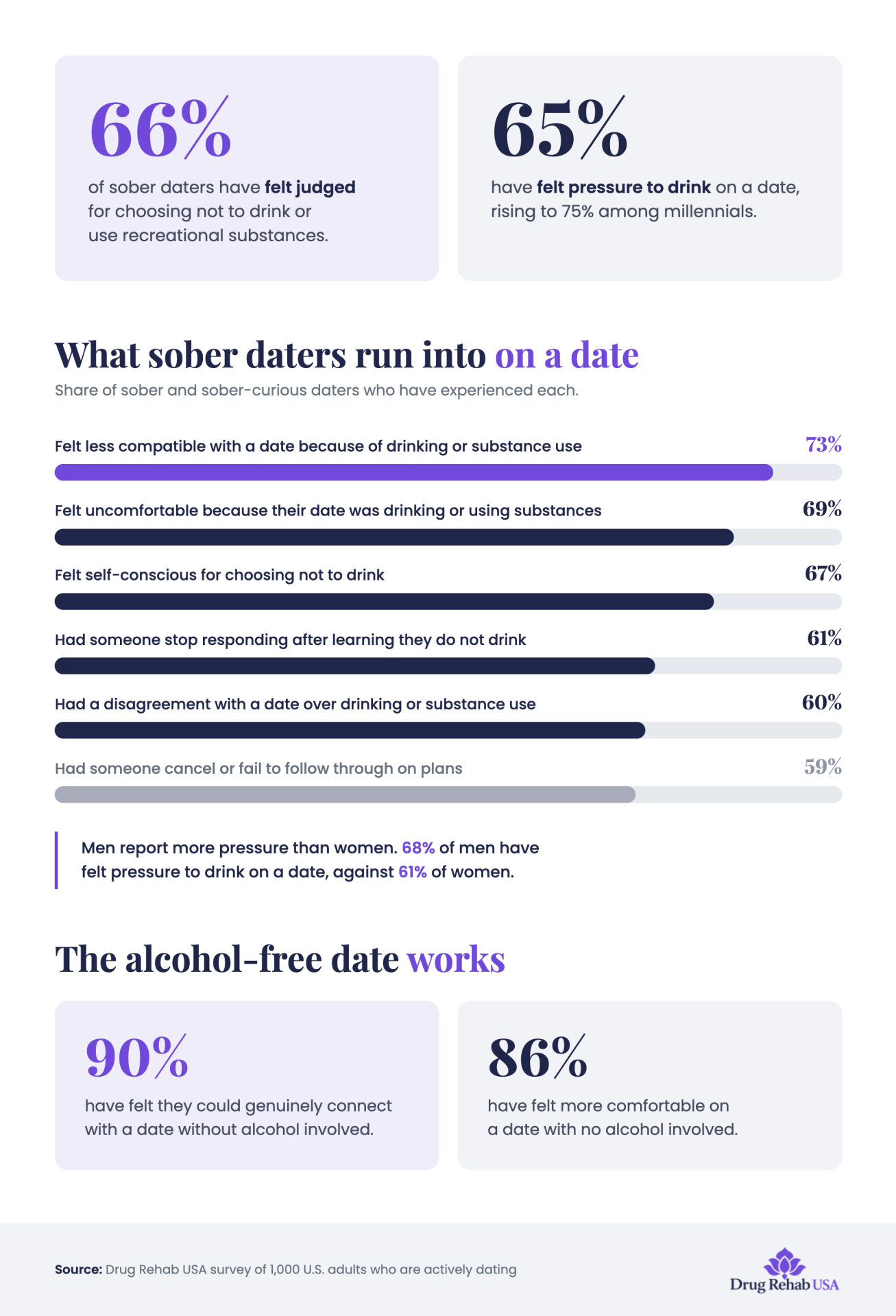
Nearly three-quarters (73%) have felt less compatible with a date because of drinking or substance use. Slightly fewer (69%) have felt uncomfortable because their date was drinking or using substances. Over two-thirds (67%) felt self-conscious for choosing not to drink, rising to 77% among millennials. A similar share (66%) had felt left out when others drank, including 74% of Gen Z. For some, these behaviors lead to conflict: 60% said they’d had a disagreement with a date because they were drinking or using substances.
Some potential partners lost interest when they found out their date was sober. Two-thirds (67%) have had a date seem less interested once their decision came up, and a similar share (66%) have felt judged for choosing not to drink or use recreational substances. Another 61% have had someone stop responding altogether after learning they do not drink. Over half (59%) have had someone cancel or fail to follow through on plans, rising to 69% among Gen Z and falling to 44% among baby boomers.
Other potential partners try to change their date’s decision. Nearly two-thirds (65%) have felt pressure to drink on a date, while 55% have felt pressure to use recreational substances. Men reported more pressure than women, with 68% of men feeling pressured to drink vs. 61% of women, and 60% of men feeling pressured to use substances vs. 48% of women. While men on first dates may hold back on encouraging their date to drink out of worry, women seem more comfortable encouraging their male matches to drink or do drugs. Millennials reported the most pressure to drink, at 75%. Younger generations also faced more pressure to try recreational substances, with 67% of Gen Z and 65% of millennials saying so, against 29% of baby boomers.
However, many sober daters found that their choice actually worked in their favor. The majority (90%) have felt they could genuinely connect with a date without alcohol involved, and 86% have felt more comfortable on an alcohol-free date. Over two-thirds (70%) have had someone become more interested or supportive after learning they do not drink. While sobriety can narrow down the dating pool, it can also make room for genuine lifelong connections.
Hiding It, Faking It, Skipping It
When you’ve only exchanged a few messages with someone before meeting in person, it can be difficult to judge how they’ll react to your sobriety. For many, it feels safer to deflect from their decision or mask it altogether, with some going so far as to actively conceal their sobriety.
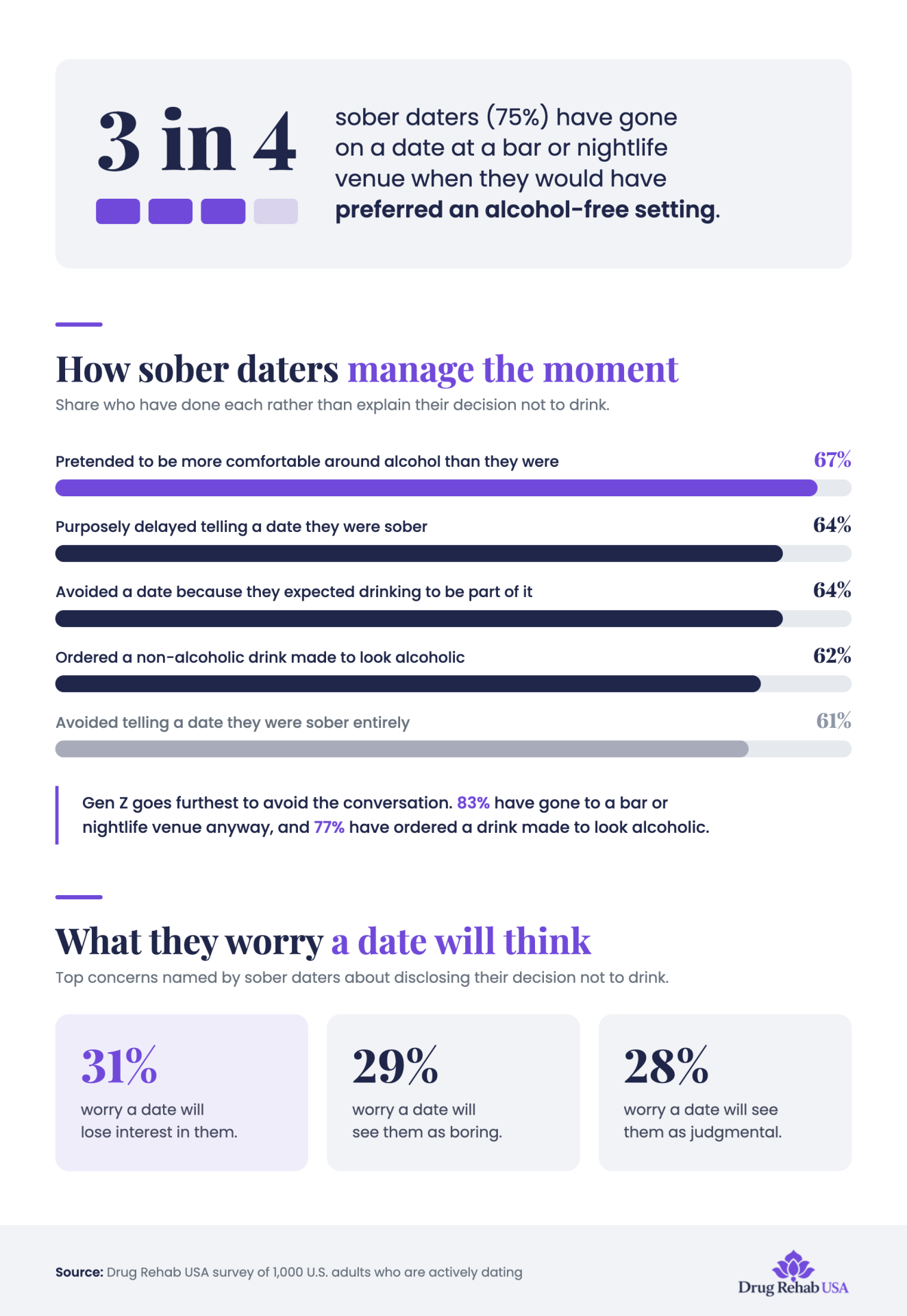
While honesty is best in theory, many sober daters weren’t upfront about their sobriety. Respondents worried that if they were, a date would:
- Lose interest (31%);
- See them as boring (29%);
- See them as judgmental (28%);
- Have a hard time connecting with them (25%);
- Misunderstand their reasons (20%);
- Assume they are religious (15%).
Many went to great lengths to avoid this conversation. Three-quarters (75%) have gone on a date at a bar or nightlife venue when they would have preferred an alcohol-free setting. Once there, 67% pretended to be more comfortable around alcohol than they actually were – or made moves to downplay the fact that they weren’t drinking. Nearly two-thirds (62%) had ordered a non-alcoholic drink made to look alcoholic to avoid questions. Another 64% have purposely delayed telling their date they were sober, and 61% have avoided it entirely. Some skipped the evening altogether, with 64% avoiding a date because they expected drinking would be part of it.
Gen Z was the most likely to go along to get along. Over four in five (83%) of Zoomers had gone to a bar or venue even though they preferred an alcohol-free environment, and 77% had ordered a mocktail to deflect from the fact that they weren’t drinking. However, Gen Z was also the most likely to avoid the situation altogether: 77% of the generation had avoided a date because they thought drinking would be involved. The youngest generation is eschewing alcohol and finding ways to navigate the dating world without it.
Almost Nobody Wants To Go To The Bar
Sometimes you do want to go where everyone knows your name – but for people who are sober, that place is usually a coffee shop. While bars have long been a go-to spot for first dates, they can also be intensely uncomfortable for someone who’s trying to avoid alcohol. In its place, sober singles are looking to new locations to get to know each other.
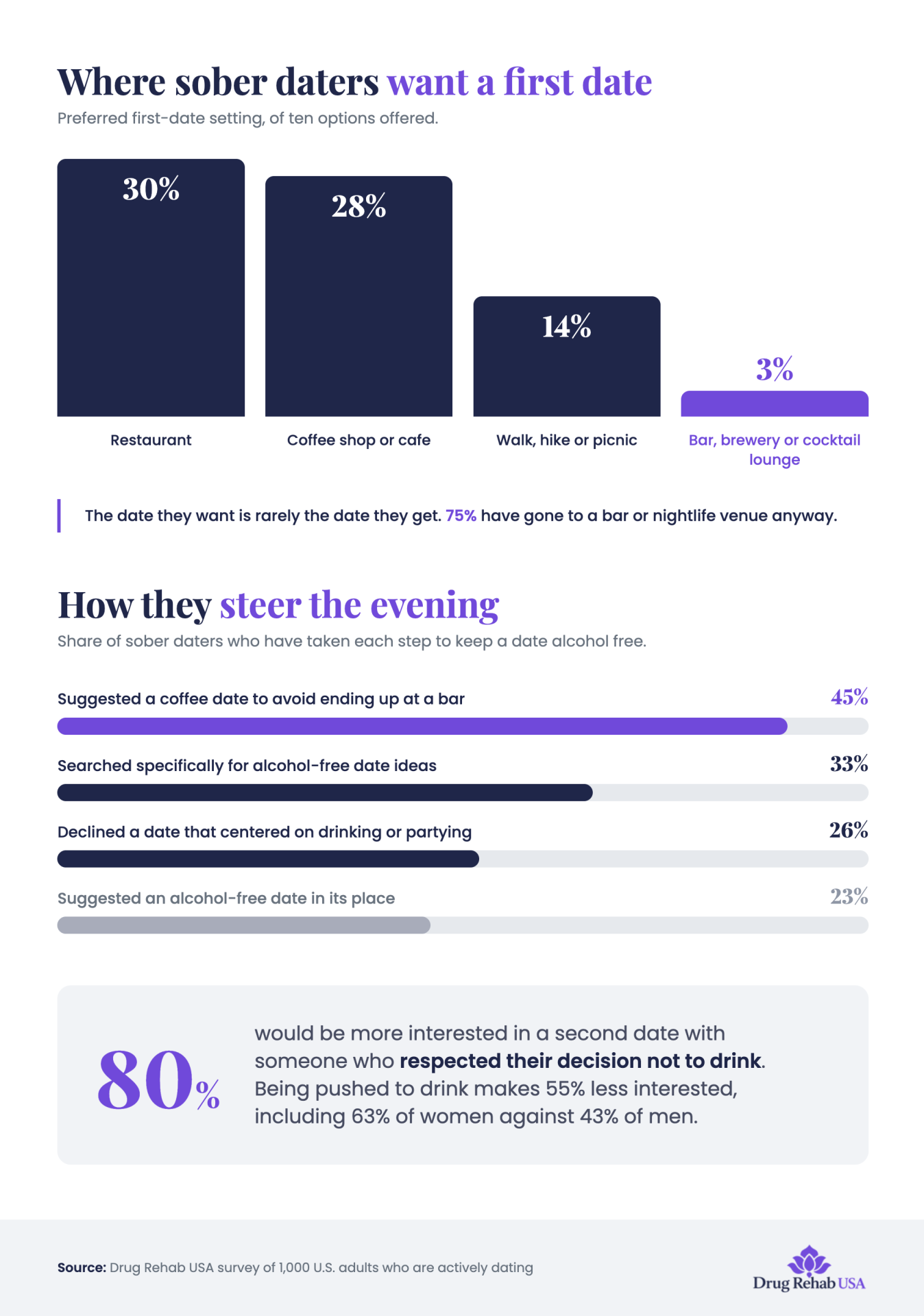
Bars were predictably unpopular among sober daters. Only 3% of respondents picked a bar, brewery, or cocktail lounge as their preferred first-date setting, tying a concert for the least popular of ten options. Not one baby boomer (0%) chose a bar. A restaurant was the most popular option at 30%, with coffee shops and cafes close behind at 28%. Another 14% preferred to go on a walk, hike, or picnic with a potential partner.
Sober daters often proactively steer the date in an alcohol-free direction. Over two in five (45%) have purposely suggested a coffee date to avoid ending up at a bar. Another 33% have searched specifically for alcohol-free date ideas. Over a quarter (26%) have declined a date that centered on drinking or partying, and 23% have suggested an alcohol-free date in its place.
That steering works when a date goes along with it. Four in five respondents (80%) would be more interested in a second date with someone who respected their decision not to drink. Another 74% would be more interested in a date who suggested an alcohol-free activity, and 73% in one who chose a venue with alcohol-free options. Respondents rewarded the attitude above the arrangements – a date who says nothing about someone ordering soda instead of wine is the one most likely to get a second date.
Conversely, people draw back from those who don’t respect their sobriety. More than half (55%) would be less interested in someone who pushed them to drink. More women drew that line than men, at 63% against their 43%. Just under a third (30%) would still be interested in a date who encouraged them to drink against their preference, rising to 44% among millennials. This represents a small but significant share of people for whom avoiding alcohol is not a hard line – and they’d still be interested in a partner who pushes it.
The Dating App Filter That Does Not Exist
Dating apps have evolved from simple swipe-and-type apps to detailed profiles on someone’s music taste, pet peeves, and intentions. But very few apps have a built-in feature to match people who are sober, instead relying on people to put it in their bios or explain it while getting to know their new match. There’s demand for this kind of filter, but the apps haven’t kept up.
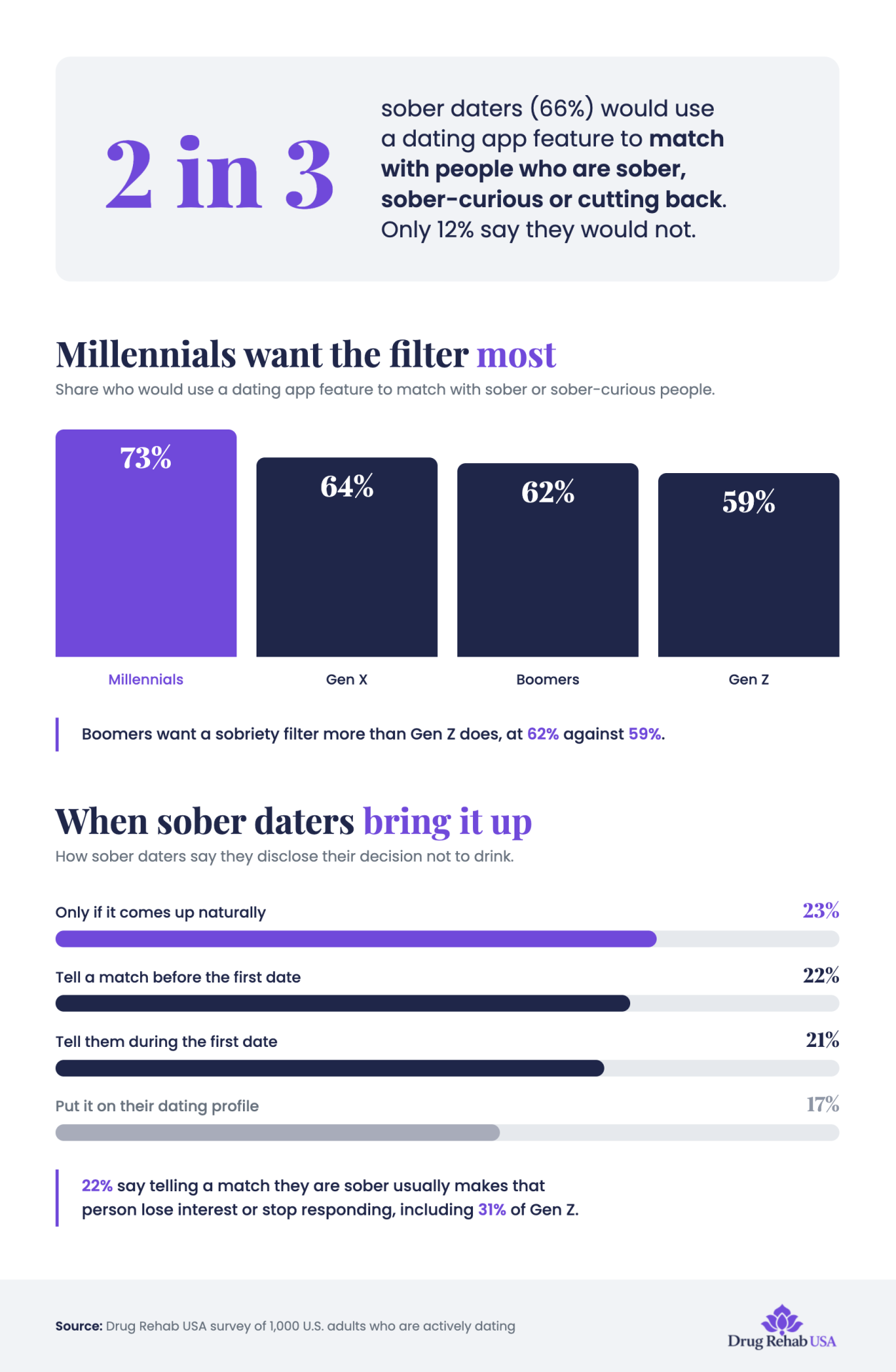
Two-thirds of sober singles (66%) would use a dating app feature to match with people who are sober, sober-curious, or cutting back. Only 12% said they would be unlikely to use one. Millennials wanted the filter most, at 73%, while Gen Z wanted it least, at 59%. Baby boomers were actually more passionate about a sobriety filter than Zoomers, with 62% of the older generation saying they’d utilize it.
The main appeal of this filter is that it would prevent a potentially awkward conversation between singles. When it comes to disclosing their sobriety, 23% only bring the decision up if it arises naturally instead of proactively bringing it up. Another 22% tell a match before the first date, 21% during that first date, and 17% put it on their dating profile. Gen X was the most upfront generation, with 22% mentioning it on a dating profile against 12% of Gen Z and 11% of millennials.
Those who avoid the conversation aren’t being deceptive. Over a fifth (22%) said that telling a match they’re sober usually makes them lose interest or stop responding, including 31% of Gen Z. However, men don’t have the same experience: 20% said that telling a date they were sober before the first date made them more interested, compared with 8% of women. Another 21% of men said that disclosing their sobriety after the first date increased their date’s interest, but only 9% of women said the same. Women may be coming up against a societal expectation to be fun and easygoing, and the men they’re dating may feel that alcohol is necessary to make that happen.
Sobriety Is Not the Dealbreaker People Expect
Dating while sober may require more intention and communication, but when done right, that can actually enhance the dating experience. Sobriety changes people’s lives in many ways, and finding a partner who accepts and understands that can take more work – but they say that work is worth it.
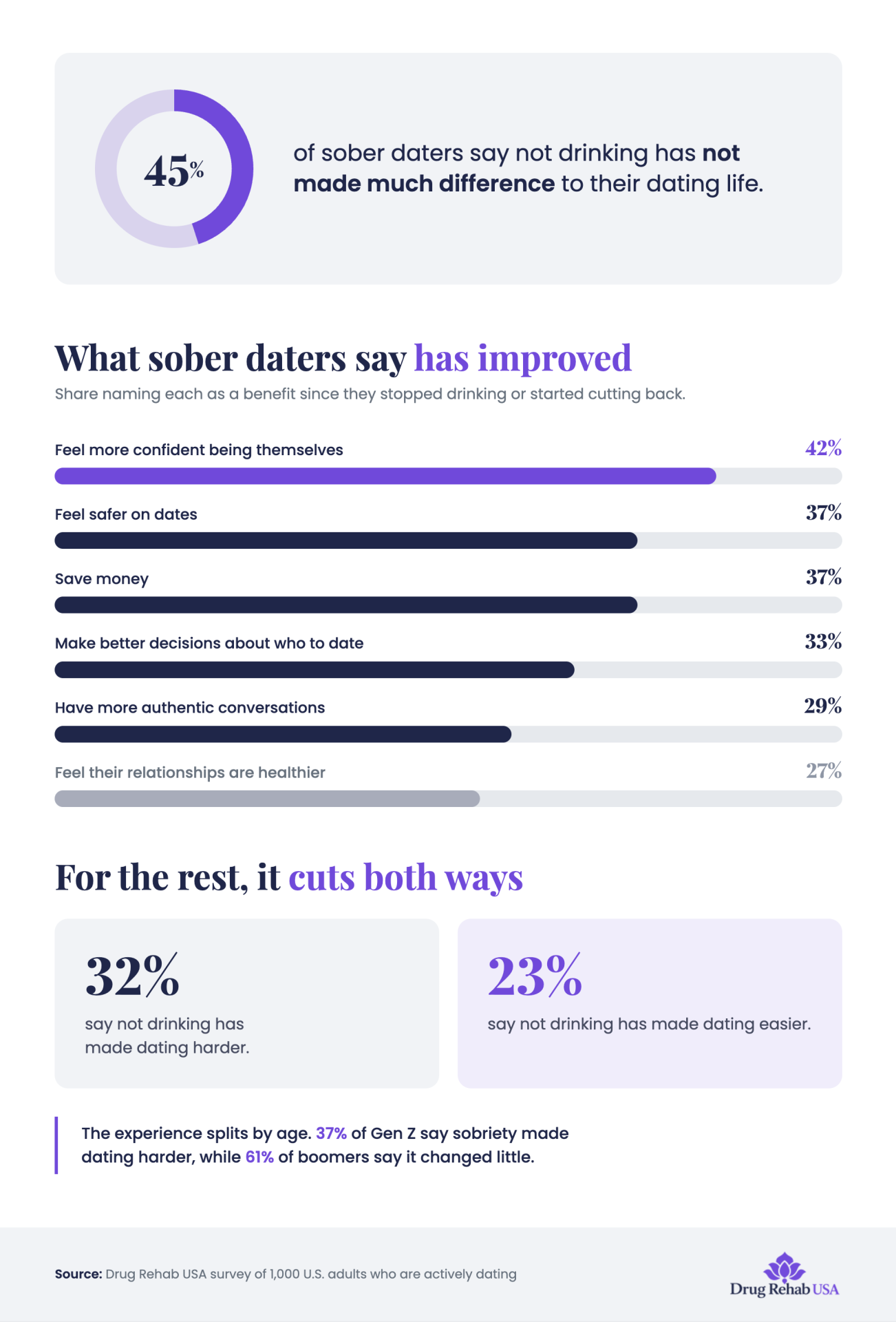
For many, sobriety changed their lives for the better, even outside of their romantic relationships. More than two in five (42%) felt more confident being themselves, including 47% of baby boomers. Another 37% felt safer on dates, rising to 41% among women, for whom the calculus about being alone with a new person changes.
Other benefits included:
- Saving money (37%);
- Making better decisions about who to date (33%);
- Having more authentic conversations (29%);
- Feeling their relationships are healthier (27%);
- Remembering dates more clearly (24%);
- Regretting fewer dates (23%);
- Forming stronger emotional connections (23%).
Results were more mixed when it came to dating, but singles were largely optimistic. Nearly half of sober daters (45%) said that not drinking has not made much difference to their dating life. Among the rest, 32% said it has made dating harder, and 23% said it has made dating easier. Boomers reported the least disruption to their dating lives, with 61% saying sobriety didn’t change much about their dating lives. On the opposite side of the spectrum, 37% of Gen Z said that sobriety made dating harder. Millennials were having the best experience: 33% of the generation said sobriety made dating easier. Sobriety costs some sober daters convenience and wins others clarity, but for most, dating goes on much as it did before.
What Sober Daters Are Actually Asking For
Alcohol does a lot of work on a first date. It gives strangers something to do with their hands and fills the first awkward hour. Take it away, and singles have more time to think about their surroundings and compatibility. That is why people who cut back often find dating harder even though nothing about them changed — the process was built for someone else.
The bind is tightest for people new to sobriety. They are advised to avoid bars, and dating culture pushes bars as the best spot for a first date. They can either go anyway or step back from dating for a while, and neither option is good for someone trying to rebuild a life. So they turn to mocktails, neutral venues, and delayed conversations.
Sober daters are not asking anyone to quit drinking or to plan a different evening. What they respond to most is a date who treats the decision as unremarkable. National drinking is at a record low and non-alcoholic options keep expanding, and dating will soon catch up.
Methodology
Drug Rehab USA surveyed 1,000 U.S. adults who are actively dating to understand how drinking culture shapes modern dating. The study was fielded through Pollfish in 2026. The sample was stratified and segmented by age and gender, with generations defined as Gen Z (18 to 29), Millennials (30 to 45), Gen X (46 to 61), and Boomers (62 and older). Results are post-stratified where available, and unweighted results are used for certain subgroup analyses where stratification is not possible. Household income subgroups were not analyzed separately because several brackets fell below the minimum sample size for reliable reporting. Percentages may not total 100% due to rounding
About Drug Rehab USA
Drug Rehab USA is an independent addiction treatment directory connecting individuals and families with more than 15,000 rehab centers and 4,000 licensed methadone clinics across the United States. Because it is not a treatment provider, the directory offers unbiased, patient-first information on treatment options, insurance coverage, and the parts of recovery that happen after treatment ends — including the social and relationship questions that come with staying sober.
Fair Use Statement
The information in this article may be used for non-commercial purposes only. If you share these findings, please attribute Drug Rehab USA and include a link back to this original research.